


🔑 Key Insights from the Amazon Web Services (AWS) Summit Toronto
-
AI makes video searchable: Investigators can use natural-language queries (e.g., “Identify unattended cash on desks”) to find critical footage in seconds, not hours.
-
Human expertise remains vital: AI narrows down footage, but trained professionals still validate results.
-
Benefits beyond Security: Compliance, operations, marketing and safety teams all gain value from AI-powered video analytics.
-
Cloud-native infrastructure drives scale: Amazon Bedrock and S3 deliver the performance and scalability needed for financial institutions.
-
The roadmap is proactive: Future milestones include anomaly detection, automated incident summaries, and real-time notifications.
Today, the financial services industry is facing several evolving challenges: more sophisticated and rising fraud, more complex compliance requirements, and the need to do more with fewer resources. Traditional surveillance, while essential, often leaves investigators sifting through hours of video footage to find a single incident.
That gap is where artificial intelligence (AI) is beginning to reshape the landscape. More than just intervening after incidents occur, AI is moving surveillance toward anticipating and preventing problems before they escalate.
At the AWS Summit Toronto earlier this month, I had the privilege of joining Mehran Najafi, Principal Solution Architect at AWS, to discuss how AI-powered visual search is moving from concept to a practical reality in the financial sector.
Here are five takeaways from our AWS Summit session for financial institutions, banks and credit unions on why implementing visual video search in their operations can take their security and operational efficiency to the next level.
1) AI turns video into searchable data
For decades, video surveillance was about recording events instead of interpreting them. Security teams often compared it to “searching for a needle in a haystack.” Traditional AI helped, but only with pre-defined objects like license plates. Each new function required expensive, time-consuming model development.
Generative AI is revolutionizing video surveillance by introducing semantic search. This means that instead of scrolling through timelines, investigators can now ask natural-language questions such as “unattended cash left on the desk” or “black SUV at the ATM.” The video image snapshots are then converted into searchable metadata, shortening investigations from hours to minutes.
This doesn’t just save time but enables a more proactive security strategy. Institutions can connect data points across multiple branches or ATMs and respond in near real time. This faster retrieval means quicker intervention, whether that’s freezing a compromised account, alerting a branch manager to a potential issue, or preventing a repeat incident.
AI visual search solutions like our AI Smart Search tool use Agentic AI and natural language prompts to find incidents and operational issues faster without needing to search through hours of video footage.
2) Human expertise is still essential
While AI is advancing rapidly, we are still in the early days. Most of today’s applications focus on analyzing video scenes and generating searchable descriptions, the search results are not always perfect. False positives and missed events are still possible, which is why human verification is still key.
Using AI visual search now can act as a “Google search for video” for security professionals. It does the heavy lifting of narrowing massive datasets down to a manageable set of clips, while investigators apply their training and context to find the issue or incident they are looking for. This balance ensures accuracy and maintains compliance with regulatory requirements, especially in the financial sector, where verification is non-negotiable.
As the technology evolves, the accuracy of AI visual searches will improve. However, human oversight will always be needed to continue to provide accountability and ensure organizations remain in control of security outcomes.
3) The value extends beyond Security teams
Generative AI surveillance has clear applications for Security and Fraud teams, but its value extends beyond security to support the entire organization. With financial institutions increasingly treating video data as a business-wide intelligence platform, the opportunities for organizational improvement are far-reaching beyond security.
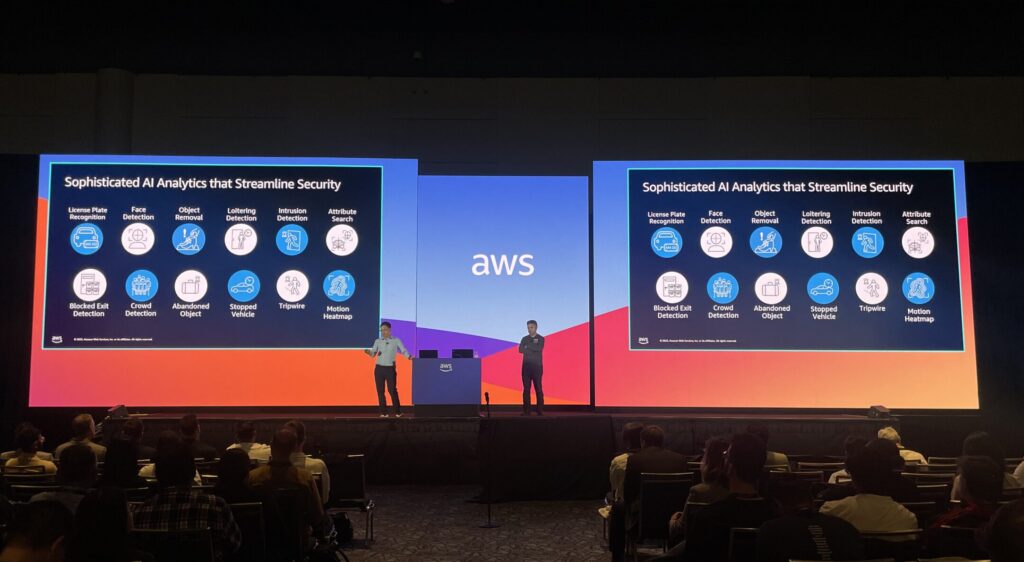
Video analytics can now support:
- Compliance teams: Easier retrieval for audits and regulatory reporting. Compliance teams can benefit from faster access to video evidence, ensuring they meet audit and regulatory reporting deadlines.
- Operations teams: Insights into branch traffic and performance to analyze traffic patterns and branch performance to optimize staffing and scheduling.
- HR & Safety managers: Monitoring workplace safety and blocked exits. Teams can monitor for workplace health and safety concerns, like blocked exits or loitering near restricted areas.
This multi-departmental value makes AI visual search more than just a security solution. It’s an enterprise-wide intelligence platform that improves efficiency, reduces risk, and contributes to customer satisfaction. By leveraging the same video data across functions, financial institutions maximize the return on their technology investments.
4) Cloud-scale AI infrastructure makes adoption viable
One reason why AI visual search is practical today is the availability of cloud-native AI infrastructure. Building and maintaining AI models in-house is costly, resource-intensive, and often impractical for regulated industries. By leveraging services like Amazon Bedrock, organizations can tap into generative AI without needing to build models from scratch. March Networks partnered with Amazon Web Services to build a generative AI search tool, AI Smart Search, that combines:
- Amazon S3 for secure storage
- Amazon Bedrock for generative AI and embeddings
- Amazon S3 Vectors for semantic search
Together, these components, orchestrated in the AWS cloud, allow hundreds of thousands of users to run natural-language queries across massive video libraries and get results in seconds.
Whether an investigator is at an office headquarters or working off a mobile device in the field, this means that they can access consistent, reliable results. Importantly, AWS’s infrastructure also brings compliance and data governance capabilities that help institutions meet regulatory obligations while innovating safely.
WATCH: AI visual search solutions like our AI Smart Search tool use Agentic AI and natural language prompts to find incidents and operational issues faster without needing to search through hours of video footage.
5) Roadmaps point toward proactive security operations
Today’s AI visual search solutions focus on helping investigators find evidence faster and operations teams pinpoint incidents and opportunities. But tomorrow’s systems will go further, transitioning from reactive to proactive security operations.
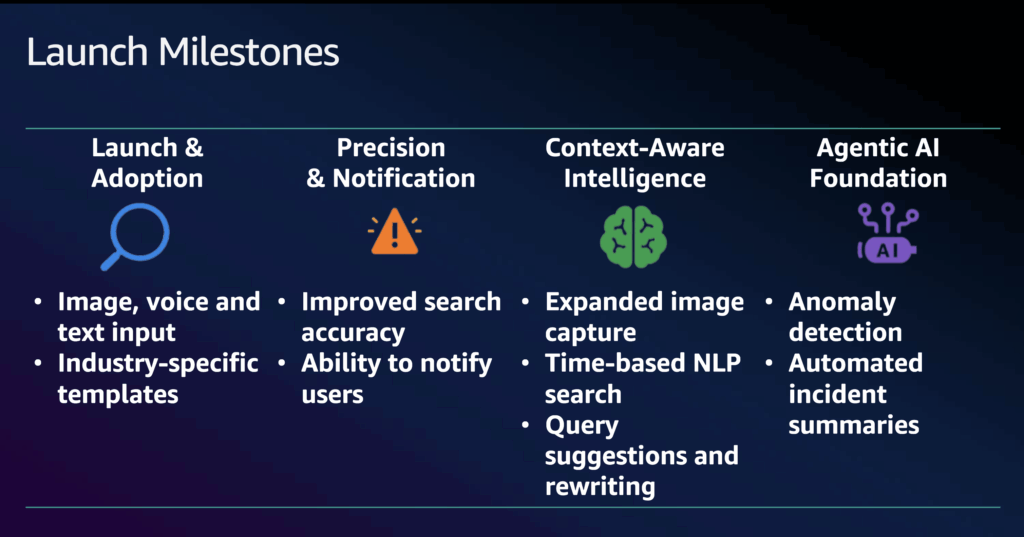
The rollout of this technology follows a strategic roadmap:
- Launch & Adoption: Initial rollout of multi-modal inputs (image, voice, text) and industry-specific templates for quick adoption.
- Precision & Notification: Higher accuracy and real-time alerts so that teams can act the moment something happens.
- Context-Aware Intelligence: New features like expanded image capture, time-based natural language queries, and intelligent query suggestions that make searches smarter and more intuitive.
- Agentic AI Foundation: Anomaly detection and automated incident summaries that significantly reduce the manual workload of analyzing footage.
This means security operations will not only become faster but also smarter. Institutions will move from asking “what happened?” to “what’s happening now?” and “what action should we take next?”
Why it matters now
Financial institutions are under constant pressure to improve efficiency, cut investigation times, and respond to increasingly complex threats. AI visual search is emerging as one of the most practical ways to achieve that balance.
By combining automation with human oversight, organizations can move toward a security model that is faster, smarter, and more resilient. This shift is not just about reducing risk, but also about unlocking new operational insights that can drive performance across the entire business.
Frank Ouyang is the Vice President of Research & Development at March Networks, where he leads innovation in video-based business intelligence and applied AI solutions. With extensive experience in software and business intelligence development, Frank is passionate about driving next-generation technologies that deliver practical, real-world impact.
Connect with Frank Ouyang on LinkedIn.
To keep up with March Networks news and updates, subscribe to our Intelligent IP Video Blog and stay connected by following March Networks on LinkedIn.