
If you manage a transportation agency—buses, rail, subway—you’re facing a challenging reality that many transportation agencies are increasingly noticing: growing ridership, rising passenger expectations, and increasing pressure to operate safely, efficiently, and transparently.
Yet even as transit networks modernize, one issue remains surprisingly common:
Most agencies still don’t have accurate, real-time insight into how many passengers are actually using their system.
This lack of visibility impacts everything, including:
- Operational and Capital Funding
- Liability investigations
- Overcrowding management
- Service planning and budgeting
- Rider experience and flow
- Staffing and safety decisions
Simply put, transit organizations cannot optimize what they cannot measure. And they cannot defend what they cannot verify.
A New Standard for Passenger Insight: AI3 Mobile Counting Camera
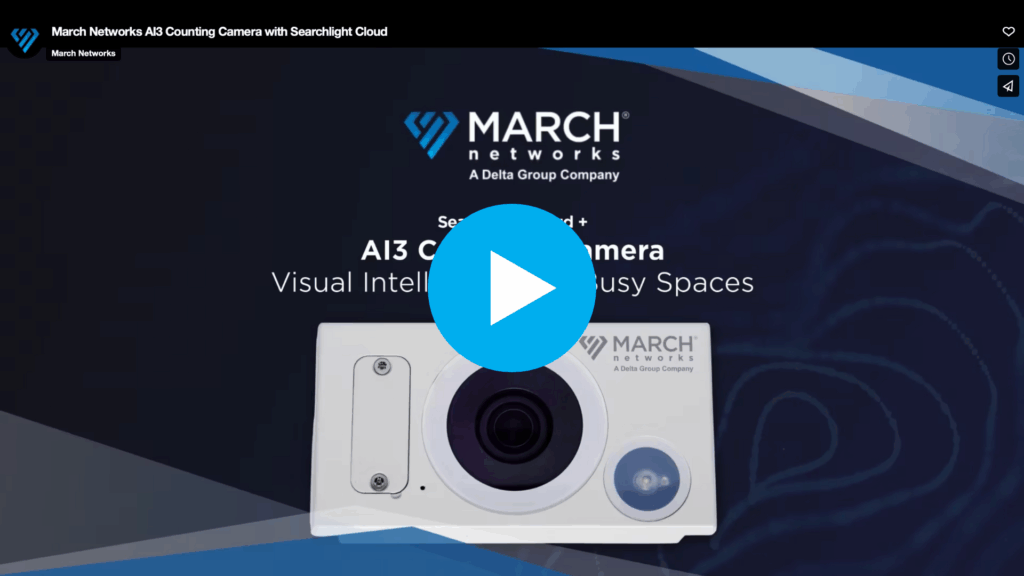
The March Networks AI3 Counting Camera is a new, AI-driven approach to understanding passenger movement. Unlike traditional sensors or manual tally methods, the AI3 offers:
- 360° video coverage
- AI-powered people counting
- Queue and dwell-time monitoring
- Demographic and staff-tag filtering
- Real-time alerts for crowd buildup
- Seamless integration with Searchlight Cloud analytics for 24/7 operational and business intelligence
All of this is delivered through a single compact device designed for both stationery and rolling stock transit environments. When it comes to safety and security on the road, Transit agencies don’t just need raw numbers—they need context, accuracy, and verifiable proof.
The AI3 Counting Camera delivers all three.
The Hidden Cost of Guesswork in Transit
Many transit networks still rely on manual counters, sampling models, IR beams, or step sensors. These aging approaches often produce unreliable data, and the consequences can be substantial.
Inaccurate counting results in:
- Underreported ridership leading to budget reductions
- Overloaded vehicles that pose safety risks
- Improper Headway management
- Delayed responses to platform or stop congestion
- Difficulties defending against false claims
- Misalignment between service levels and actual demand
Data inaccuracies erode public trust and strain resources. Reliable people counting is no longer optional; it’s foundational for transportation agencies to oversee their entire operations.
Here’s How it Works
Mounted inside a vehicle or above a boarding point, the AI3 continuously analyzes passenger movement:
- Entries
- Exits
- Queue formations
- Dwell-time spikes
- Crowding patterns
- Flow paths
Its dual-lens, 360° design allows the camera to manage common transit challenges:
- Shadows from opening doors
- Dense clusters of riders
- Fast boarding and unloading
- Low or changing light
- Overlapping movement
The AI3 Counting Camera also supports staff exclusion using visual tags, ensuring agency employees aren’t counted as passengers. This small feature dramatically improves data reliability.
Key Transit Use Cases: Analytics with Immediate Impact
Below are the most practical, high-value applications of people counting technology in transit environments.
1. Supporting Funding and Capital Planning
Many agencies struggle to justify infrastructure requests without precise ridership data. The AI3 Counting Camera and Searchlight Cloud can help provide:
- Verified ridership statistics
- Trend analyses over weeks or months
- Systemwide or route-level comparisons
- Video-backed evidence for proposals
This strengthens the case for capital investment, enabling agencies to demonstrate need clearly and confidently.
2. Defending Against Liability Claims
Liability is one of the most expensive issues transit agencies face. Slip-and-fall claims, overcrowding allegations, and disputed incidents often rely on conflicting testimony.
The AI3 Counting Camera captures:
- How many passengers were present
- When and where a person boarded
- Congestion levels at a specific moment
- Rider flow leading up to an incident
Because each data point is automatically associated with video snapshots, agencies can quickly reconstruct events. This significantly improves investigations and speeds up resolution.
3. Preventing Overcrowding and Improving Safety
Transit environments can become congested in seconds—particularly during rush hour, sporting events, or service delays.
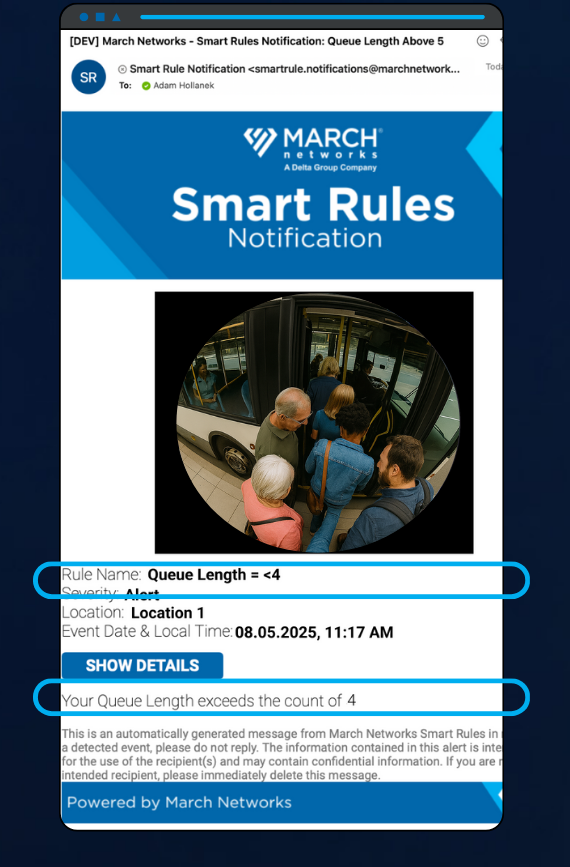
With the AI3 Counting Camera and Searchlight Cloud’s real-time alerts with Smart Rules, agencies can set thresholds that trigger instant alerts when conditions become unsafe such as:
- Excessive queue lengths
- Platform crowding
- Extended dwell times
- Restricted zone presence
Messages like “Queue at Gate B Exceeds Safe Limit” or “Northbound Platform Congestion Detected” help operations teams respond before conditions worsen.
4. Enhancing Route Planning and Headway Management
Planning teams need reliable data to adjust service levels or justify expansion. The AI3 provides:
- Stop-level boarding and exit counts
- Peak boarding and alighting periods
- Weekday vs. weekend ridership patterns
- Detailed dwell-time data
- Comparisons across multiple routes or vehicles
This allows planners to allocate resources accurately—whether increasing capacity, adjusting timetables, or optimizing stop placement.
5. Improving Rider Experience by Reducing Bottlenecks
Passenger experience is shaped by:
- How quickly they board
- How safe they feel
- How smoothly they move through stations
- Whether dwell times cause delays
AI3 data helps transit managers identify patterns:
- Where crowding consistently forms
- Which entrances slow down movement
- Where additional signage, staff, or barriers may help
- Which times of day require increased supervision
Better flow improves customer satisfaction and overall system reliability.
Real-Time Alerts and Historical Reporting in One System
Transit requires both immediate situational awareness and long-term planning insight. The AI3 delivers both.
Real-Time Capabilities via Smart Rules
- Queue detection
- Platform crowd buildup
- Prolonged dwell times
- Restricted-area presence
Smart Rules push alerts instantly to supervisors or operations centers, enabling rapid intervention.
Historical Analytics via Searchlight Cloud
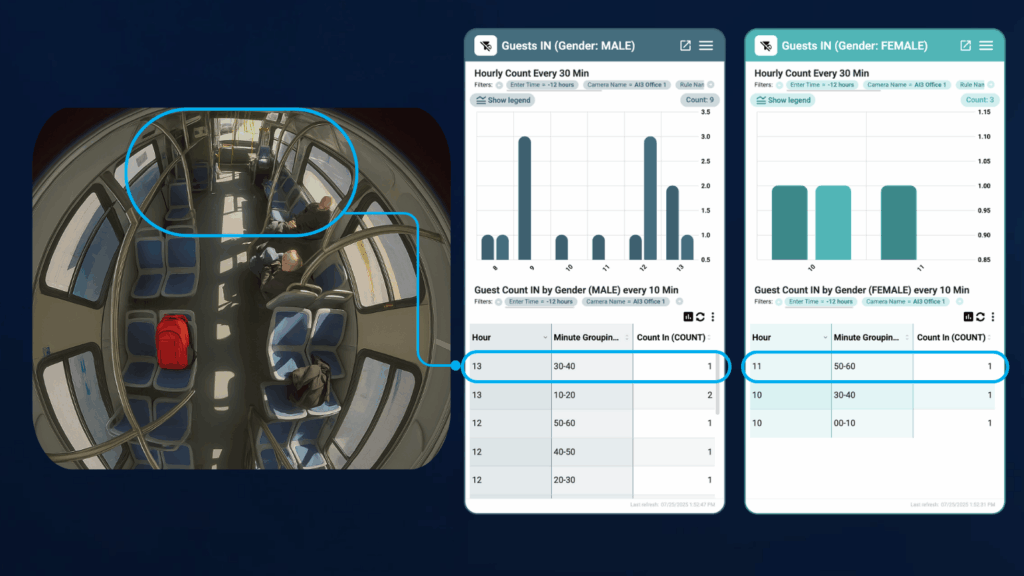
Searchlight Cloud centralizes insights into dashboards that agencies can share across planning, operations, and safety teams, including:
- Ridership by route or stop
- Onboard passenger trends
- Time-of-day boarding patterns
- Multi-vehicle comparisons
- Presence and dwell-time heat patterns
- Systemwide analytics
Staff Exclusion for Cleaner, More Accurate Data
Transit systems often have a significant number of onboard employees: drivers, inspectors, cleaners, and station staff.
The AI3 uses a visual tag to exclude them automatically, ensuring:
- More accurate ridership counts
- Cleaner dwell-time data
- Better service planning
- Fewer false crowding alerts
This enables agencies to trust the data without manual correction.
Final Thoughts: The Future of Transit Depends on Smarter Data
Transit organizations worldwide are under growing pressure to improve safety, efficiency, and customer experience. People counting is no longer just a metric but a foundation for better decisions, safer operations, and stronger accountability.
The March Networks AI3 Counting Camera gives agencies powerful new capabilities:
- Highly accurate, AI-driven passenger counts
- Platform and onboard crowd detection
- Liability protection through video-backed data
- Improved flow and customer satisfaction
- Smarter service planning and resource allocation
With real-time alerts and cloud-based analytics, transit agencies now have visibility over their operations in a way that they have historically struggled to achieve.
See the AI3 Counting Camera in Action
If your agency is ready to enhance safety, improve planning, and reduce liability risk, explore how AI-powered people counting can transform your system.
Contact our transit specialists or request a demo to learn more.